Bosch eBike Battery Not Charging: How to Fix a Dead Battery
Bosch eBike battery dead fix refers to resolving a state where the battery pack fails to provide power or respond to the charger. The first practical step is to
Bosch eBike battery dead fix refers to resolving a state where the battery pack fails to provide power or respond to the charger. The first practical step is to press and hold the battery power button for 15 seconds to reset the internal Battery Management System (BMS).
⚠️ SAFETY WARNINGS
Remove battery before any work
Wait 5+ minutes for capacitor discharge
NEVER bridge positive and negative terminals
Use insulated tools only
Do not test ride if you smell burning or feel excessive heat
When a Bosch battery appears “dead,” it usually signifies that the Battery Management System (BMS) has entered a protective lockout state or the communication protocol between the battery and the Bosch Drive System has been interrupted. This is not necessarily a mechanical failure of the cells, but often a logic or connectivity error. On specific Bosch models, the system may show no signs of life if the voltage drops below the threshold required to wake the internal controller.
Symptom
Root Cause
Severity
Estimated Repair Time
No LEDs on battery
BMS Lockout/Deep Discharge
High
15-30 mins (Reset)
Display on, but no power
Connection/Contact failure
Medium
10 mins
Error 410 appearing
Communication error
Medium
20 mins
Charger shows “Error”
Voltage/BMS mismatch
High
N/A (Requires Dealer)
What causes a Bosch battery to stop working?
Technical failures in Bosch systems often stem from environmental or electrical stressors. Moisture ingress through the battery casing or the charging port can lead to pin corrosion, preventing the 5V logic reference from communicating with the display. In coastal areas with high salt air or in humid climates, oxidation on the contact points is a common culprit. Furthermore, vibration damage from rugged trails can loosen the internal connection between the cells and the BMS, or damage the EB-BUS main harness if it is improperly routed. Pressure washing damage is particularly notorious for forcing water past the seals, leading to internal short circuits or MOSFET failure within the controller.
Quick Fix: Resetting your Bosch battery in 5 steps
If your battery is unresponsive, follow these rapid recovery steps to attempt a BMS reset:
Remove the battery: Physically detach the battery pack from the eBike frame.
Initiate Reset: Press and hold the power button on the battery pack for 15 seconds.
Inspect Contacts: Check the connection terminals for visible debris or moisture.
Reseat Battery: Re-insert the battery firmly and ensure the locking mechanism clicks.
Power Cycle: Turn the eBike display on and check for motor engagement.
How to fix a dead battery step by step
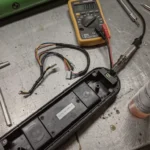
If the quick reset fails, you must move into a professional diagnostic workflow. You will need a digital multimeter, electronic contact cleaner, and dielectric grease.
Testing the voltage at the battery terminals is the priority. Use your multimeter to check the output. If the voltage is significantly lower than the nominal rating (e.g., below 36V for a 48V system), the BMS may have tripped a safety fuse. If the voltage is correct but the bike won’t start, the issue lies in the communication protocol or the connector pins.
Check the connection pins for signs of “blooming” or green oxidation. Clean the pins using a specialized contact cleaner and apply a thin layer of dielectric grease to prevent future moisture ingress. If the error persists after cleaning, the internal BMS may be permanently locked, requiring professional service.
Common Mistakes to Avoid
Overcharging a dead cell: Never attempt to force-charge a battery that shows 0V; this can cause thermal instability.
Using non-Bosch chargers: Using third-party chargers can disrupt the communication protocol and trigger a permanent lockout.
Ignoring moisture: If the battery was recently in heavy rain, do not attempt to charge it until it is completely dry.
Forcing the connection: Never apply excessive pressure to the battery terminals if they don’t seat easily.
Frequently Asked Questions
Is it dangerous to jump-start a Bosch battery?
Summary: No, do not attempt this.
Attempting to bypass the BMS with external power can destroy the controller’s MOSFETs and cause a fire hazard. Always use the official Bosch charger.
When should I replace my battery instead of fixing it?
Summary: Replace if cells are swollen or voltage is unstable.
If you notice physical swelling of the casing or if the battery fails to hold a charge for even a short ride, the internal cells are likely compromised and the pack must be replaced.
Can I use a different charger to fix the error?
Summary: Only use official Bosch chargers.
While other chargers might provide voltage, they lack the specific communication protocol required to “talk” to the Bosch BMS, which can result in a permanent error code.
How do I prevent battery death in humid climates?
Summary: Use protective covers and clean contacts regularly.
In high-humidity or coastal areas, use a dedicated battery port cover and apply dielectric grease to the terminals every few months to prevent salt-air corrosion.
Check the battery terminals for any signs of physical damage before attempting to recharge the unit.
This guide is based on real-world experience with Bafang motors. If the error persists or you notice burning smell or abnormal heat, consult an authorized service center.
Frequently Asked Questions
Is Bosch error code 410 dangerous for my motor or battery?
Summary: Error code 410 is a system error indicating a malfunction in the drive unit.
Error code 410 is a system error indicating a malfunction in the drive unit. It is not inherently “dangerous” like a fire risk, but it will disable motor assistance to protect the hardware.
This code typically signifies an internal communication or sensor error within the Bosch Drive System. If you notice the motor feels cogged or makes a grinding noise, stop riding immediately to prevent permanent damage to the internal gear assembly.
When should I replace my Bosch battery versus repairing it?
Summary: Replace your battery if the BMS (Battery Management System) has failed or if cells are chemically unstable.
Replace your battery if the BMS (Battery Management System) has failed or if cells are chemically unstable. Repairing is only viable if the issue is a simple external connection or contact point problem.
If the LEDs on the battery pack do not respond when you press the power button, the internal management circuit may be unresponsive. For safety and electrical integrity, a dead BMS usually requires a full replacement rather than a component-level repair.
Can I fix a Bosch battery not charging at home?
Summary: You can perform a soft reset at home by removing the battery and holding the power button for 15 seconds.
You can perform a soft reset at home by removing the battery and holding the power button for 15 seconds. If this fails, you likely need professional diagnostic tools.
This manual reset attempt attempts to wake the battery’s internal controller. If the charger outputs a low voltage without recognizing the pack, the communication handshake between the Bosch charger and the battery is failing, requiring a specialist dealer inspection.
How do I prevent my Bosch battery from dying early?
Summary: Avoid storing your battery at 0% or 100% charge for long periods.
Avoid storing your battery at 0% or 100% charge for long periods. Aim for a storage level between 40% and 70% to maintain long-term cell health.
Extreme temperature fluctuations in US climates, such as high heat in California or deep freezes in New York, can degrade the lithium-ion chemistry. Always keep the battery in a temperature-controlled environment when not in use to prevent capacity loss.
Why does my Bosch battery stop charging after a long ride?
Summary: This is often caused by thermal protection triggers.
This is often caused by thermal protection triggers. If the battery cells are too hot from heavy usage, the BMS will temporarily block charging to ensure safety.
After high-intensity climbs or long commutes in summer heat, the internal temperature may exceed safe thresholds. Allow the battery to cool to ambient room temperature before attempting to reconnect the charger to avoid triggering a permanent error state.
I am a specialist in technical diagnostics and advanced electric bicycle repair. I founded Fix E-Bike Code with a clear mission: to demystify the electronic faults and complex error codes that impact modern electric mobility. My approach combines engineering theory with hands-on workshop experience, allowing me to deliver precise and safe solutions for every system.
Throughout my career, I have specialized in Battery Management Systems (BMS), firmware optimization, and controller diagnostics for the market’s leading manufacturers. I understand that an e-bike is not just a mode of transport, but a piece of technology that requires precision. Therefore, I document each of my procedures with the goal of raising technical standards within the community of enthusiasts and mechanics.